Porn, Performance and the Search for Real Intimacy

Most of us receive very little education about intimacy. We learn how to read, write, work, and to navigate the practical demands of life. Yet when it comes to relationships, emotional connection, and sexuality as a form of intimate expression, most of us are left figuring things out on our own. To make things worse, pornography has become the most accessible and searched for source of information about sex, at least in the last two decades, with the democratization of online access.
The question in this article is not whether pornography is morally good or bad. Instead, the most interesting question we should ask is: What is pornography actually teaching us about intimacy? And even more importantly: What can it ever teach us at all?
When Porn Becomes the Teacher
For many people, and I would dare say not just but men especially, pornography is found long before meaningful conversations about intimacy, relationships, communication, emotional safety, or even connection. As a result, it has become a silent teacher for many of us. One that is there, but no one really talks about. And the sad reality is not so much that we consciously decided to learn from it, but rather that repeated exposure to it has slowly shaped our thoughts, ideas, desires, expectations, habits, and ways to act towards others in real life.
The way we find it these days, pornography is designed to lock our attention, and create the desire for fast stimulation and instant gratification. Like sugary junk food or a drug, it is made for fast consumption as a way to numb us temporarily, not to build any kind of depth or intimacy in relationships. Just as a hit of any drug won’t ever teach us about coping with reality as it is, pornography is not designed to teach us anything about awareness or emotional connection.
Its focus is on visual excitement, fantasy, novelty, and performance. It doesn’t show us what happens before or after physical intimacy, conversations, trust, triggers, vulnerability, awkwardness, emotional connection, the genuine curiosity that allows two people to truly discover each other. These are the very elements that create meaningful intimacy and they are absent from the screen when one scrolls down another porn fix.

The Rise of Performance-Based “Intimacy”
Along with turning both women and men as mere objects, devoid of any human depth, one of the strongest messages we absorb from pornography is that sexuality is something to be performed. And with the idea of performance comes the expectation, and the pressure to know what to do, to be confident, to act a certain way, to move a particular way, to offer each other some kind of pre-determined experience or reach a particular outcome.
For many men, as well as women, this often leads to performance anxiety and self-doubt. All this because instead of taking intimacy as a form of expression, discovery and connection, while being with one another, partners and lovers become focused on questions such as:
"Am I doing this right?" or “Is he/she doing this right?"
"Am I good enough?" or “Is he/she good enough?
"Am I satisfying my partner?" or “Is my partner satisfying me?”
The attention moves away from exploration as a form of connection, into self-evaluation or evaluation of the other. Many men and women may also experience a different version of the same dynamic: that the other for instance is following a script or a pre-determined agenda, rather than genuinely responding to them. Rather than feeling deeply seen, we end up feeling used or performed to. Rather than feeling met, we simply feel disconnected from one another -two people physically close, while emotionally very distant from each other, and not intimate at all.
What Porn Cannot Teach
Pornography can suggest a few positions, often without much creativity. It can explore a few fantasies - probably the only thing it can actually really offer, besides the fact that It can teach us performance without intimate connection.
Porn does not teach presence. Or in other words, it won’t ever teach us the ability to be fully engaged with what is happening in the present moment - with ourselves and the other. Being present and fully engaged means slowing down and paying attention. It means listening within as well as without, feeling ourselves and the other. Responding with awareness. Being connected to ourselves while remaining connected to our partner. Presence cannot be performed, it cannot be mastered through technique alone. It arises from practicing it. By simply being present and aware.
And this is the difference between an experience that feels merely physical and disconnected on one hand, and one that feels deeply intimate, on the other. And here’s what most people miss out on: this full presence and deep intimacy is exactly where real pleasure and orgasms are experienced. Because when we slow down and become present with one another, we develop sensitivity to all that is subtle: changes in breath, energy moving, moments of tension, moments of relaxation, moments when our partner opens, moments when they withdraw or space out. Presence is what allows intimacy to become a dialogue, rather than some kind of scripted performance.

Why Many People Feel Unseen
One of the most common complaints in relationships is not necessarily a lack of sex. It is a lack of deeper connection. Deep inside, even if our attachement style, makes it feel scary, we all long to feel seen, met and understood.
Yet when intimacy is replaced by the desire to achieve a particular outcome, genuine connection ends up taking the back seat. In my years working as a somatic relationship and intimacy practitioner, women constantly shared that what they desired most was not impressive technique but greater presence, attunement, and emotional connection. In the hundreds of men’s circles I led over the last decade, men often expressed a desire to feel accepted, rather than evaluated by size, erection stamina or performance.
Despite our natural and conditioned differences, beneath the surface, both men and women are often searching for the same thing: connection. The feeling that someone is truly with them. Seeing them, hearing them, fully present, instead of distracted, performing, or trying to achieve something out of their own agenda. Feeling seen goes much deeper than just feeling desired.
Curiosity Creates Intimacy, Not Technique
Some of us spend years trying to learn how to become better lovers. But few spend the same amount of time learning how to really become curious about the other. Curiosity changes everything in a relationship. Instead of assuming what your partner wants, likes or desires, have you ever tried to ask? Instead of following a script, have you ever tried to explore together? Instead of trying to impress your partner, have you ever tried to listen and observe here with curiosity and awareness?
Every person we meet is different, and every relationship we engage in is different. We all come from different places and with our own baggage. It’s just natural that what feels safe, turns on, gives pleasure or induces relaxation, varies from person to person. No technique can replace curiosity and exploration. In fact, curiosity is indeed what allows intimacy to stay alive over time, and allow two people to continue discovering each other. After all, we age every day, our bodies change, and so do our minds, so curiosity is really the only way to keep updated about one another.
Emotional Safety: The Foundation of Intimacy
There is another ingredient that porn never shows: emotional safety. When people feel emotionally safe, they truly relax. And when they do, they become more authentic. From here, intimacy naturally happens. Emotional safety is created through trust, honesty, consistency, reciprocity. Through knowing that one's boundaries, emotions, and experiences matter. Without emotional safety, there is no space for intimacy. With emotional safety, genuine connection happens and intimacy deepens. Emotional safety contributes much more to the quality of intimacy than sexual expertise will ever do.

Foreplay Starts Long Before the Bedroom
One of the most limiting ideas about intimacy is the belief that foreplay is a set of techniques one or both perform on the other shortly before love-making. This is a good example of how misleading porn often is about sex itself. In reality, foreplay begins much earlier. It begins in everyday interactions, in the way partners speak to one another, in how conflict is handled, in whether appreciation is expressed, in whether someone feels truly heard or valued. In whether emotional connection is nurtured throughout daily life.
The message sent during the day, the short hug just before leaving home, the curious conversation over dinner, the way one listens when our partner is stressed. These are the moments that build trust, safety, and connection. They create the conditions in which intimacy can naturally flourish. Seen from this perspective, foreplay is not a sequence of techniques - that is a pretty limited and narrow view on the theme - it is the ongoing cultivation of deeper connection in a relationship.
Returning to What Matters Most
Porn may inspire fantasies. It may teach performance without connection. But at the cost of seeing our partners as mere objects that we use to fulfil our needs. When it comes to real intimacy, the kind that is raw and runs deep, porn has nothing to teach you or me. It cannot teach trust, vulnerability, presence, or even genuine curiosity for the other. These are qualities that emerge through the exercise of real human connection: in relationships. Frail and imperfect as they may be.
Through communication, through slowing down enough to truly feel and meet another person. Perhaps the most important shift happens when we stop asking: "How can I be better in bed?" And start asking: "How can I be more present with my partner (or my lover)?" Because deep intimacy does not grow with performance. Intimacy grows from the willingness to meet another person exactly where they are.
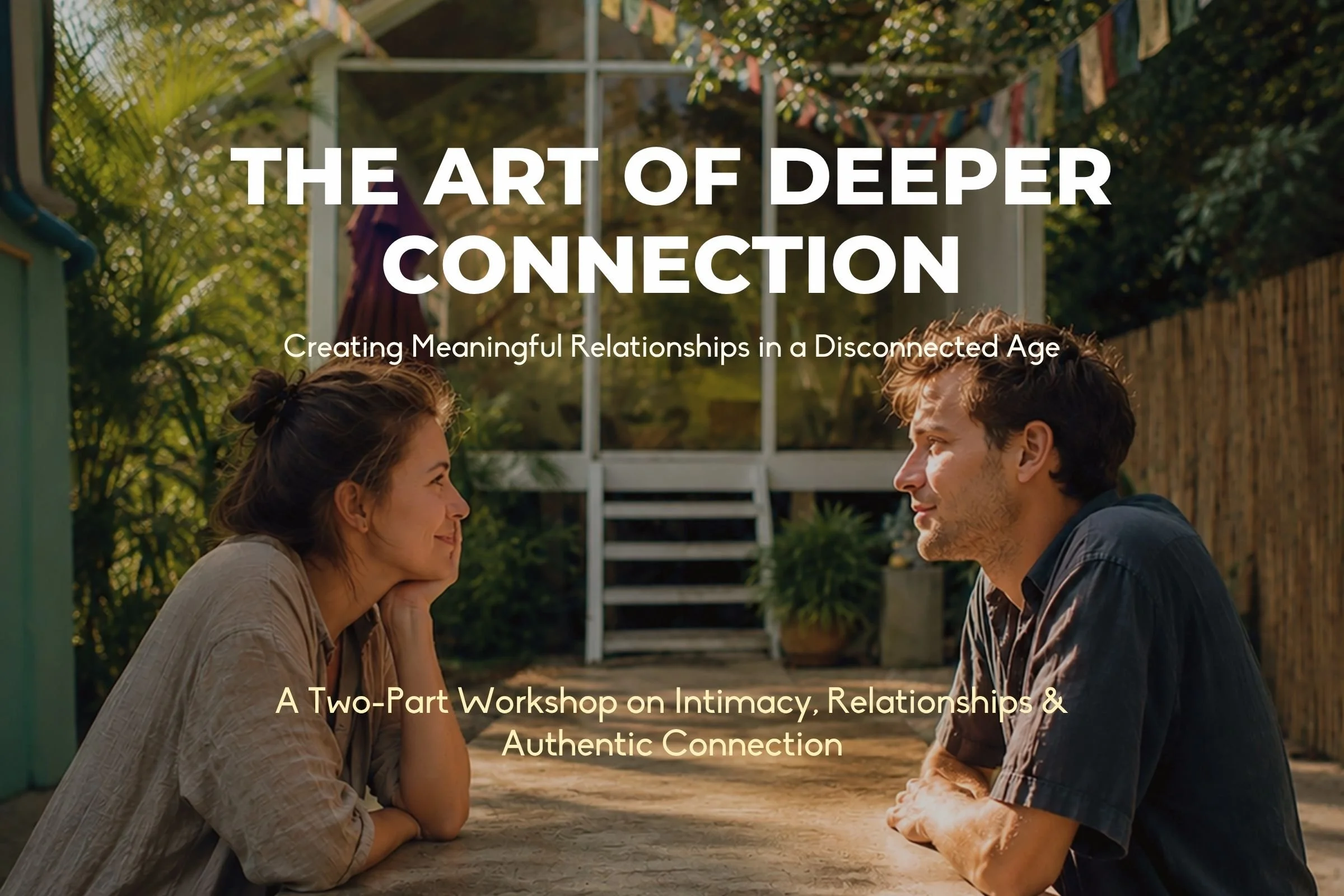
The Art of Deeper Connection
If intimacy is built on presence, trust, emotional safety, and genuine connection, then these are skills worth developing. The Art of Deeper Connection is a workshop designed to explore the foundations of meaningful human connection, both within ourselves and with others. Through guided exercises, discovery practices, and experiential learning, participants discover how to move beyond performance and into authentic presence.