What Is Traditional Tantra? Understanding the Trika Śaiva Tradition
Tantra is one of the most misunderstood spiritual traditions to emerge from India. In contemporary Western culture, the word is often associated with sexuality, intimacy, conscious relationships and personal development. Yet these associations tell only a small part of a much larger story.
Traditional Tantra encompasses diverse spiritual traditions with their own views, teachings, practices and approaches to self-realization. Among them is the Trika Śaiva tradition, a sophisticated non-dual school that flourished in Kashmir around the turn of the eleventh century, brought together by the philosopher and Tantrik master Abhinavagupta.
At the heart of this tradition lies a radical understanding of consciousness: the reality we seek to discover is not separate from the awareness through which we experience the world.
Understanding Trika requires looking beyond its non-dual philosophy to the different Tantrik currents that inform it, and to the relationship between spiritual practice and realization.
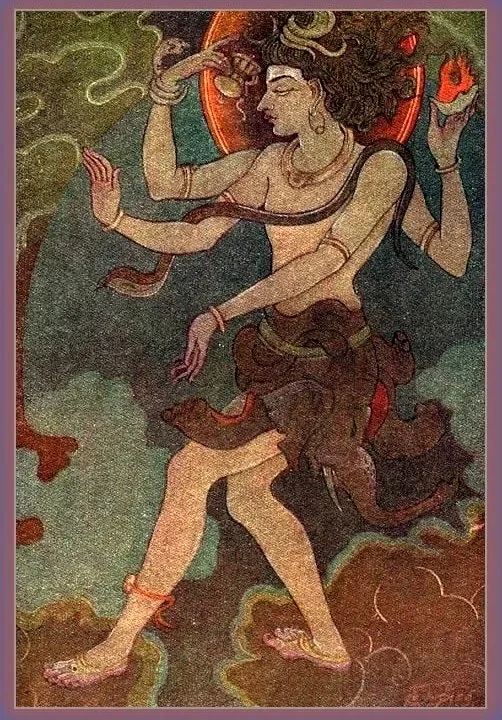
Śiva as Natarāja, the Lord of the Dance. Śiva's dance expresses the dynamic activity of consciousness: creation, maintenance, dissolution, concealment and grace.
What Is Traditional Tantra?
Tantra is not a single religion, philosophy or set of practices. It is found in a range of traditions that sometimes cross-polinated view and methods between themselves, but developed their own systems, between Central and South Asia, particularly within Śaivism, Śāktism, Yung Drung Bön, and later on Tibetan Buddhism, for at least three millennia.
These non-dual Dharma traditions meet at the very depth of their core views, even if they seem to differ at the surface, or even disagree when it comes to their own understanding of what full liberation actually means. A few of these traditions are even non-sectarian, which means they accept, recognise and respect the others as parallel paths, leading to full realization. They also share an emphasis on oral transmission, a recognised lineage of masters or teachers as a focal point, and a system of practices put together and passed on from teacher to student, such as mantra, ritual, initiation, meditation, deity yoga and other different methods intended to transform the practitioner's perception of reality.
The Sanskrit word tantra has several related interpretations and uses, including a system, framework or body of teachings. Its meaning depends on the context in which it appears. It should not be reduced to a single literal translation.
In many Tantrik traditions, spiritual practice is not simply a matter of adopting particular beliefs or withdrawing from ordinary life. It involves specific methods through which the practitioner seeks to understand, transform or directly realize the nature of reality.
Trika emphasizes three different paths, or approaches to practice (also referred to as entry points) to self-realization: body, speech (energy) and mind. Within these approaches, practices may include devotion to a deity, ritual offerings, yoga, mantra sadhana, meditation. In reality, they usually combine several of these practices at once. The Four Upāyas (further below in this article) explain these different approaches a bit deeper.
It is therefore more accurate to speak of Tantrik traditions in the plural than to imagine one universal system called Tantra.
To understand what Tantrik practice is really about, it is important to understand the tradition from which it comes, the view that informs it and the purpose for which it is undertaken. Trika Śaivism provides a particularly rich example of this integration.
What Does Trika Mean?
Trika means a triad or threefold grouping. Within the tradition, the name has several levels of meaning, including the three goddesses Parā, Parāparā and Aparā, who represent fundamental aspects of Śakti.
Trika also encompasses other triadic principles and classifications through which the relationship between consciousness, its power and manifestation is understood: Dharmakaya, Sambogakaya, Nirmanakaya.
It is understood that Tantra existed several millenia before Abhinavagupta. His contribution was to develop an influential synthesis of Tantrik teachings by combining three important schools, integrating them into a wider non-dual Dharma tradition.
Three currents are particularly useful for understanding this synthesis: Kaula, Krama and Pratyabhijñā.
Abhinavagupta and the Synthesis of Three Tantrik Currents
Abhinavagupta was a Tantrik practitioner, philosopher and scholar whose work brought together diverse traditions of Śaiva and Śākta thought. His Tantrāloka is a major exposition of Tantrik philosophy, ritual and spiritual practice.
Rather than treating different teachings as isolated systems, Abhinavagupta explored how their methods and insights could be understood within a comprehensive vision of consciousness.
Kaula: ritual, Śakti and embodied practice
Kaula encompasses diverse Tantrik traditions with distinctive ritual systems, initiatory structures and teachings concerning Śakti.
Its practices may involve mantra, deity yoga, ritual and contemplative methods through which the relationship between the practitioner, the divine and manifestation is explored.
Kaula is particularly important to understanding the ritual and practical dimensions of Abhinavagupta's synthesis. It should not, however, be reduced to dualistic Śākta Tantra: Kaula traditions are diverse, and important currents are explicitly non-dual.
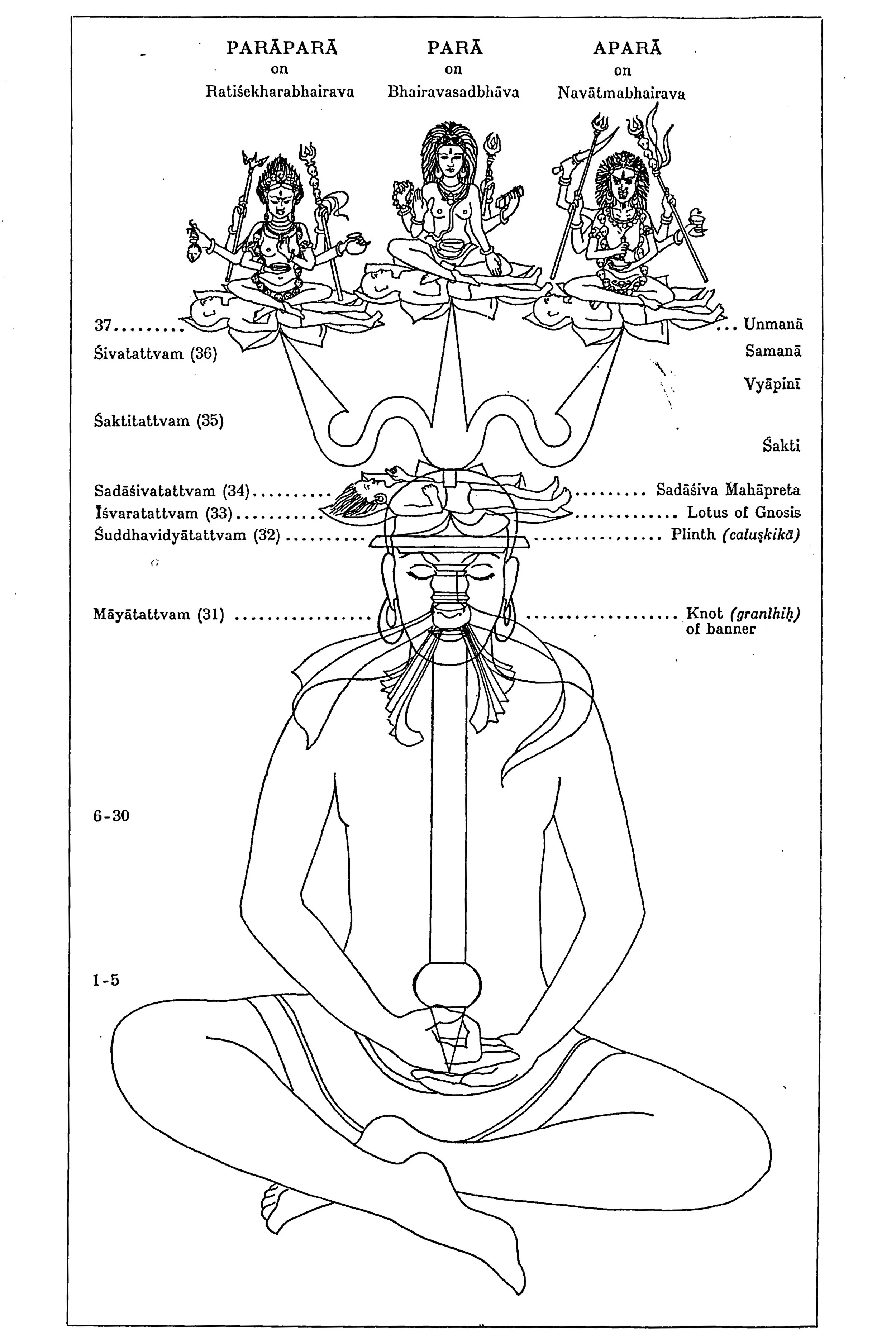
The mandala throne and the three goddesses enthroned upon it, as visualised along the axis of internal sensation during internal worship.
Krama: the unfolding of consciousness
Krama, meaning sequence or progression, is a Śākta Tantrik tradition particularly associated with Kālī and the successive processes through which experience manifests and returns to its source.
Its teachings explore the dynamic nature of consciousness, the succession of experiential moments and the possibility of recognition through the unfolding of awareness.
Abhinavagupta integrated important Krama teachings into his wider system, bringing their distinctive contemplative and ritual perspectives into dialogue with non-dual Śaiva philosophy.
Pratyabhijñā: recognition of one's true nature
Pratyabhijñā means recognition. This philosophical tradition, developed by thinkers such as Somānanda and Utpaladeva, offers a systematic account of consciousness, self-awareness and liberation.
Its central insight is that realization involves recognizing one's true nature as consciousness, rather than acquiring something entirely new or reaching a reality wholly separate from existence.
In Abhinavagupta's synthesis, Pratyabhijñā provides an important philosophical framework through which the significance of Tantrik practice and realization can be understood.
Understanding their different orientations
These three currents can be explored through different orientations towards the relationship between the individual, divine power and ultimate reality.
In one interpretive framework, Kaula emphasizes the relationship between the practitioner and Śakti through ritual and embodied practice; Krama emphasizes the progressive unfolding and recognition of consciousness; and Pratyabhijñā articulates the non-dual recognition of consciousness as the fundamental reality.
Some traditional presentations further describe these orientations through distinctions between dualistic (Kaula), semi-non-dual (Krama) and non-dual (Pratyabhijñā) approaches. Such classifications can be useful, but they should not be treated as universal definitions of the three traditions. Kaula and Krama both contain important non-dual teachings.
The significance of Abhinavagupta's synthesis lies in how these distinct currents are brought into a wider framework of non-dual Śaiva Tantra, rather than simply ranked as separate philosophies.
The Four Upāyas: Different Means of Realization
Alongside these Tantrik currents, Trika describes four upāyas, or means of realization. They provide a separate framework for understanding how recognition may be approached.
Ānavopāya: practice through the individual, including disciplines such as mantra, meditation, visualization and breath-related methods.
Śāktopāya: the means associated with Śakti, emphasizing awareness, understanding and the refinement of thought.
Śāmbhavopāya: a more direct approach associated with will and immediate awareness of consciousness.
Anupāya: realization without a further conventional method, where recognition is immediate.
The four upāyas should not be equated directly with Kaula, Krama and Pratyabhijñā. They describe different paths of realization.
Nevertheless, they help clarify an important dimension of Trika: spiritual practice can take different forms, according to the path approached to realizing one’s true nature. The relationship between method and realization is central to Abhinavagupta's presentation of the tradition.
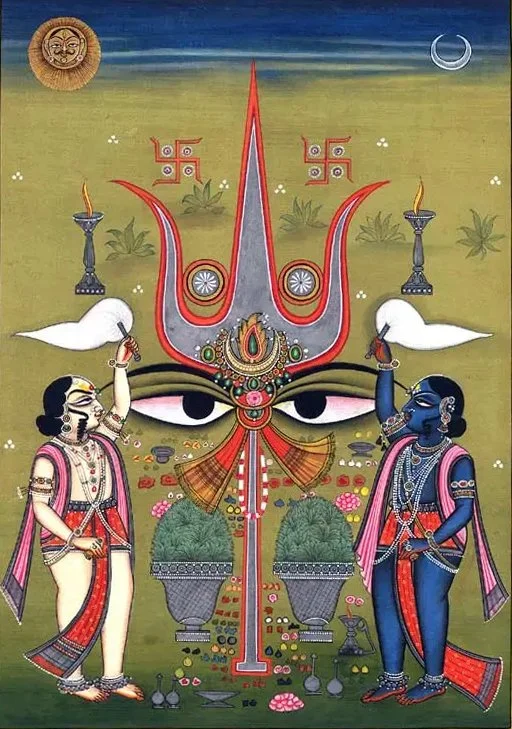
Tantric devotional painting depicting a trident (triśūl) with Śiva and Śakti next to it.
Śiva and Śakti: The Non-Dual Vision of Trika
The wider synthesis of Śiva and Śakti is grounded in a non-dual understanding of reality. Śiva represents the fundamental nature of consciousness, while Śakti is its inherent power and potential to manifest and express itself. They are not two independent realities, but inseparable dimensions of one reality.
From this perspective, the world is not ultimately separate from consciousness. Manifestation expresses the freedom and power of consciousness itself. Non-duality encompasses Duality. One does not exist without the other.
This does not mean that every experience automatically leads to liberation. The distinction between ordinary awareness and recognition remains essential and is many times misunderstood in certain modern spiritual circles.
The purpose of spiritual practice is not simply to accumulate unusual experiences or adopt an exotic philosophical belief. It is to engage with the teachings and methods through which the nature of consciousness may be recognized.
This relationship between view, method (or direct practice) and fruit of the practice is one of the defining characteristics of non-dual Trika Śaiva Tantra.
What Does Traditional Tantrik Practice Involve?
Traditional Tantra brings it’s view into practice through methods that may include mantra, meditation, ritual, visualization and devotion.
Mantra, for example, is not understood simply as a sound repeated to calm the mind. Within Tantrik traditions, it is understood in relation to the energy body of a deity, Śakti, consciousness and the power it contains within.
Meditation likewise encompasses a variety of methods, from structured disciplines involving attention and visualization to contemplative approaches directed towards recognition itself.
All Tantrik practices require initiation and specific instruction. Even those publicly shared from translated scriptures lack particular instructions that only an authorized lineage teacher can transmit. Often only orally, to preserve the strength of lineage transmission.
This is why traditional Tantra cannot be reduced to a collection of techniques. Its practices belong to a larger system inn which view, method and fruit of the practice inform one another.
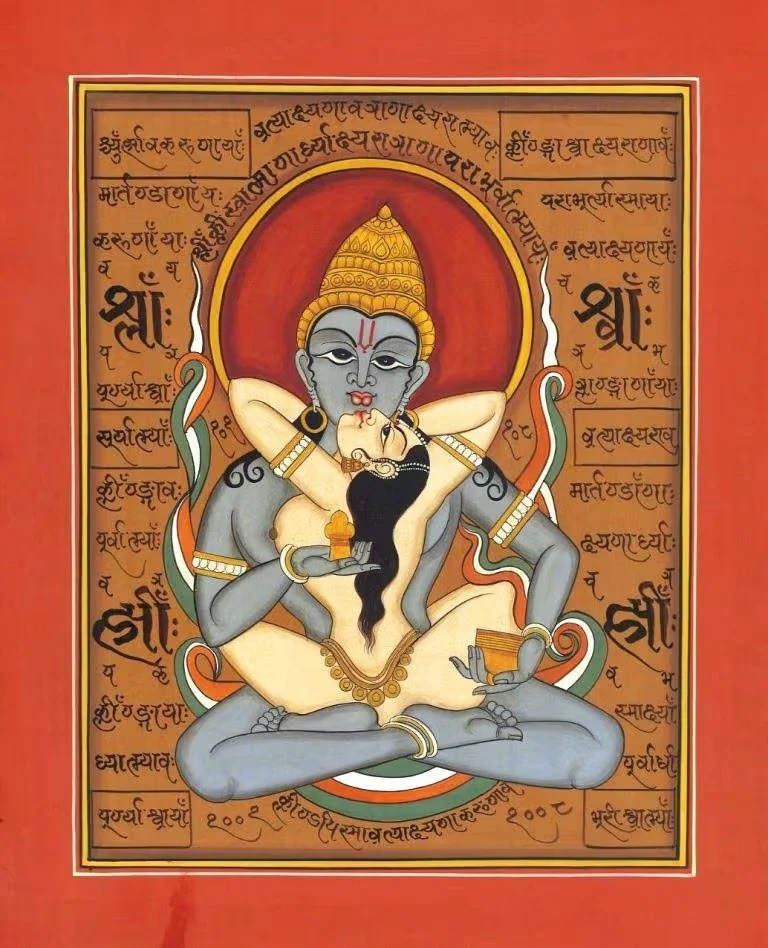
Śiva and Śakti in sexual embrace, seated in yogic posture Yab Yum.
Is Tantra About Sexuality?
Sexual practices exist in Tantrik traditions, but sexuality is far from being a sufficient definition of Tantra and is definitely not the defining feature of Trika Śaivism or any form of classical Tantra. Furthermore, it is not to be introduced until advanced stages of practice, as practitioners easily fall prey to yet another form of delusion and attachment, through hedonism, thus reifying one’s ego structure ever more deeply, which is exactly what the Tantrik practice is intended to break apart.
Modern Neo-Tantra encompasses a wide range of practices involving intimacy, embodiment, relationships and sexuality. Some of these practices draw inspiration from Indian Tantrik traditions, while incorporating contemporary psychological and therapeutic approaches. Although these practices may have their own value, they should not be equated with classical Tantra. It is important to understand that Neo-Tantra is more of a set of wellness practices directed towards the well-being of the practitioner, through opening up to pleasure, and as such, it’s end goal is not liberation through realization of one’s true nature.
Traditional Tantra encompasses a broad field of teachings and practices, a deep View from which the whole system emerges, a Method directed towards the recognition of one’s true nature, and the understanding of Fruit of the Practice as a reference to the previous. The fruits of the practice are verifiable. And this is why lineage traditions are so important: as with science, in which any fundamental assertion is peer-reviewed, so is the fruit of the practice verified by teachers/masters who have been on the path. As they were also verified by their teachers, within their own traditions. In any traditional Tantrik system, view, method and fruit of the practice co-exist and are inseparable. And so is the lineage mandala in which teachers and students coexist.
The distinction is not about dismissing contemporary wellness approaches, using the same name. It is about understanding both their origins, and aims accurately.
Exploring Traditional Tantra at Sacred Grounds CNX
At Sacred Grounds CNX in Hang Dong, Chiang Mai, our approach to traditional Tantra also emphasizes the relationship between view, method and practice.
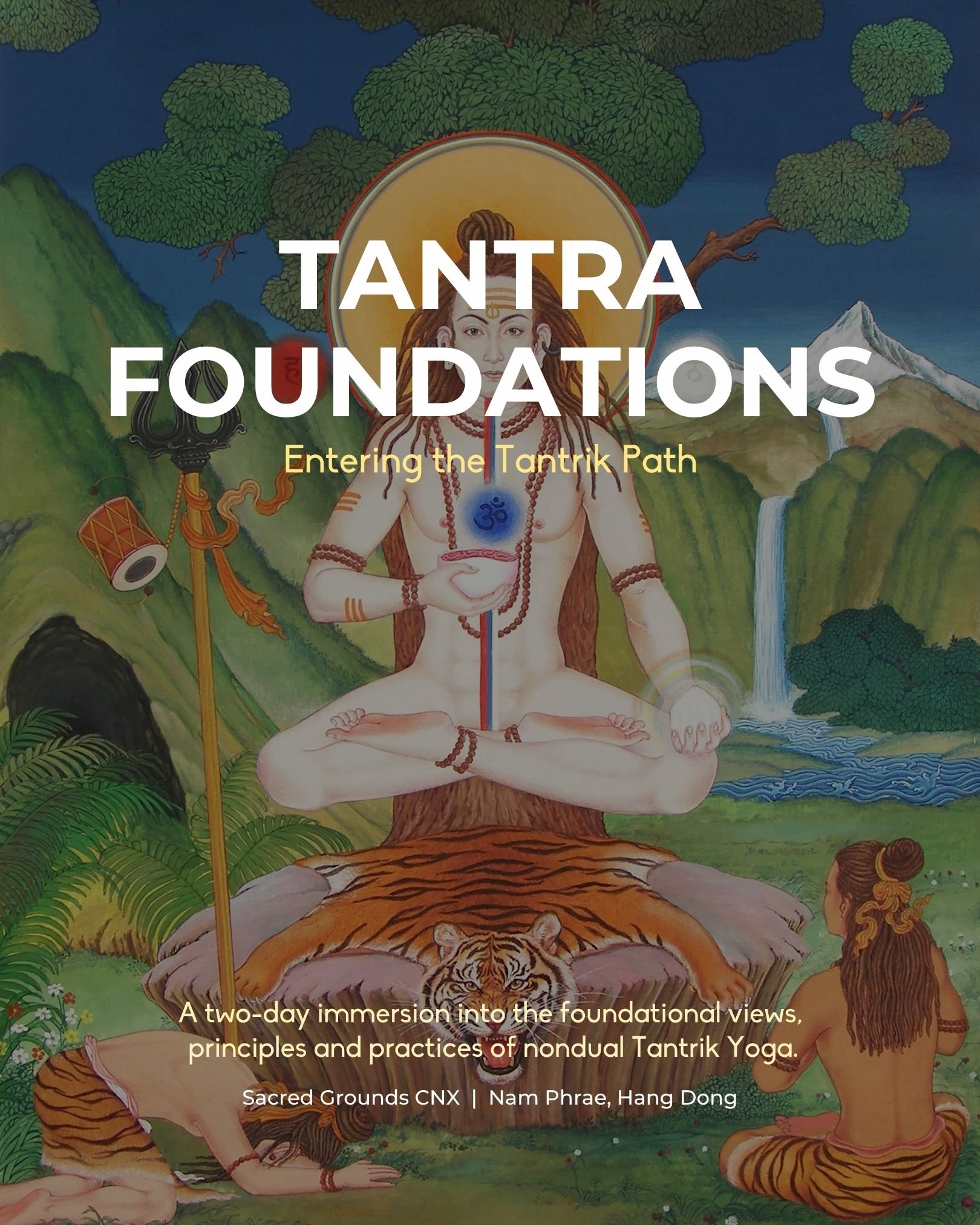
Through offerings such as Tantra Foundations and Mantra Sādhanā, we explore foundational Tantrik teachings, mantra and contemplative methods within their philosophical context.
Even though there is much more to say when it comes to the practices we offer and the deeper meaning of Trika to us, our intention is to offer entry points that make this tradition accessible, without reducing it to another diluted spiritual or wellness trend.
For those interested in exploring Tantra beyond its new age interpretations, studying the Trika Śaiva foundational practices, getting introduced to Mantra Sadhana, or even joining the practice of Kundalini Hatha Yoga, offers a meaningful starting point: understanding not only what a practice involves, but also the deeper view that gives these methods much deeper significance.
Conclusion
Trika Śaivism is more than a philosophy of non-duality. It is a rich and deep Tantrik tradition whose development brought together different systems into one.
Abhinavagupta's synthesis of Kaula, Krama and Pratyabhijñā illustrates the depth of this integration. The four upāyas provide a complementary framework for understanding the different means through which realization may be approached.
Together, these teachings present a tradition in which philosophy and practice are inseparable dimensions of the path towards recognition.
To understand traditional Tantra is therefore to look beyond familiar labels and explore the relationship between its teachings, its methods and the realization they are intended to serve.