Śākta-Śaiva Tantra is a living spiritual tradition in which consciousness and its creative power are understood as inseparable dimensions of ultimate reality. At its heart is a non-dual understanding of existence: Śiva represents pure consciousness, while Śakti is its inherent power of manifestation. They are not two separate principles, but inseparable dimensions of one fundamental reality.
Its teachings encompass a rich body of view, method and practices concerned with the nature of consciousness, the power underlying existence and the possibility of spiritual realisation. Yogic practices such as mantra sadhana, meditation, devotion, hatha yoga, and the oral transmission of knowledge from teacher to student are all important dimensions of this tradition.
At Sacred Grounds CNX, our approach is rooted in the teachings transmitted through Ananda Math and Shaktibad Math by Swami Satyananda Saraswati. Our school also draws from the non-dual Trika tradition of Kashmir Śaivism. Together, these teachings inform a path of spiritual development grounded in traditional Tantrik principles and disciplined practice.
At its heart is a non-dual understanding of reality: consciousness and its power, Śiva and Śakti, are not two separate principles. They are inseparable dimensions of one fundamental reality. Understanding this relationship is essential to understanding the tradition we practise and teach.
This is a path for people living in the world. It is not a renunciate path. It does not require withdrawal from family and social responsibilities, by the contrary, it embraces them to their fullest: It invites practitioners to cultivate awareness, discipline and spiritual understanding, while remaining engaged with everyday life. Human experience itself becomes an opportunity to recognise and realise the underlying unity of Śiva and Śakti in every moment.
Understanding this tradition means looking beyond individual techniques or philosophical concepts to explore how its view, methods and practices come together in a coherent path of spiritual development and realisation.
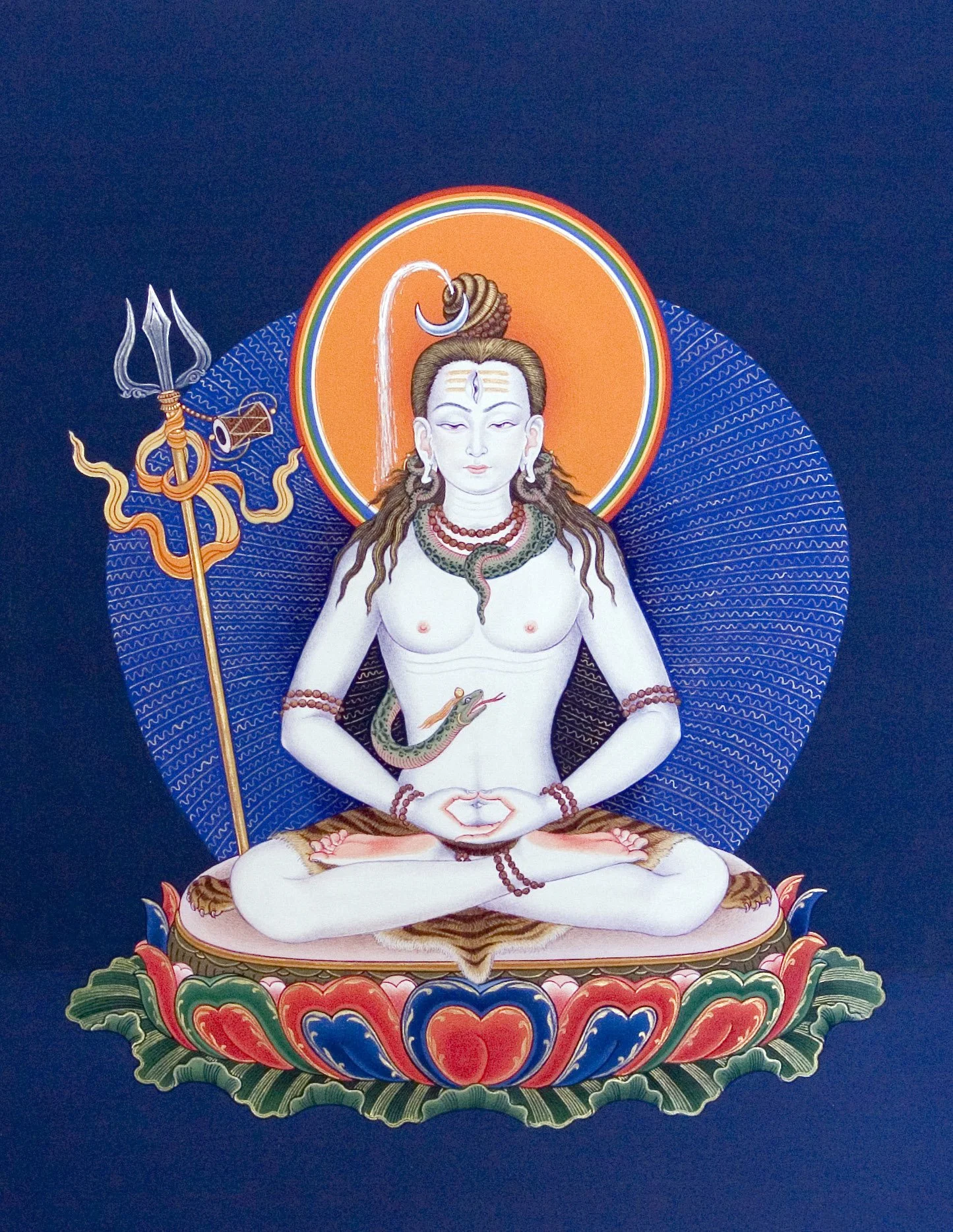
Śambhu Nātha Śiva, depicted as a Sambhogakāya (divine body of bliss) manifestation. A luminous expression of pure consciousness, representing peace, benevolence and the self-revealing light of awareness. He is the source of auspiciousness and the ground from which all existence arises. Painting by Dinesh Shrestha.
What is Classical Tantra?
The Sanskrit word Tantra is associated with the ideas of weaving, extending and systematic instruction. Historically, it refers to a broad range of spiritual traditions transmitted through teachers, oral transmission, initiation and practice. There has never been one single system called Tantra. Different lineages developed their own systems, paths, and methods of spiritual realisation. These include Śaiva traditions centred on Śiva, Śākta traditions centred on the Goddess and Śakti, and traditions in which these principles are understood as inseparable.
Tantric traditions developed across different parts of India, including Kashmir and the eastern regions of the subcontinent. They encompass philosophy, cosmology, ritual, mantra, yantra, meditation, yoga and methods of liberation.
One important characteristic of many Tantric traditions is their understanding that the world and human existence are not fundamentally separate from the sacred. The body, the senses, mind and energies of life are all manifestations of the same base. Rather than seeking liberation only through withdrawal from existence, Tantra explores how the nature of reality can be recognised through direct experience and disciplined practice. This view is common to all Tantrik systems, and it’s in the methods that most differences are found.
Śiva and Śakti: Understanding the non-dual foundation
At the heart of our Śākta-Śaiva understanding of Tantra is the relationship between Śiva and Śakti. To understand what makes this tradition both Śākta and Śaiva, we need to look beyond the familiar images of adivine couple that is outside of us, and understand the principles they represent:
Śiva represents consciousness. It is the fundamental reality, the ground of spacious awareness, the dimension through which all experience becomes possible. Śiva is not simply a mythological deity or an external creator. It is consciousness itself.
Śakti represents energy in it’s full potential, the power of manifestation. Śakti is pure dynamism, pure potential energy and capacity for expression through manifestation. Through Śakti, consciousness manifests as the universe, as life, as perception and as every form of experience.
The Śākta dimension places Śakti, the Divine Feminine, at the centre of spiritual understanding and practice. She is not merely the consort of Śiva or a secondary force. She is the supreme power through which existence unfolds. The Śaiva dimension recognises Śiva as the fundamental reality of consciousness, the ground and source of all manifestation. But these are not two separate realities: Śiva and Śakti are inseparable. Consciousness and its power cannot be divided. Śiva without Śakti would be without expression; Śakti is never separate from the consciousness of which she is the power.
This is the non-dual foundation of the tradition: the absolute and its manifestation are not two. Duality and non-duality are both aspects of the One. This means that the universe is not something external to the divine. It is an expression of consciousness through its own power. Spiritual realization therefore involves the recognition of this underlying unity, rather than simply escaping the world or rejecting the experience of being human into some sort of “non-dual delusion“. This understanding also changes how we approach spiritual practice: The body, the world around us and the energies of life are not inherently obstacles to liberation. They are the means through which the deeper nature of reality is recognised.
The Goddess and the many expressions of Śakti
In Śākta Tantra, the Goddess is approached as the living expression of supreme power. She appears through many forms, each revealing different dimensions of Śakti. Kālī, Durgā, Sarasvatī, Laksmī and the Ten Mahāvidyās are among the important emanations of Mā Prana Śakti (the Divine Mother), in different Tantric traditions. These are not simply different mythological characters. Their forms, attributes, energy bodies (mantras) and associated practices express particular aspects of divine power and the relationship between the manifest universe and its ultimate source.
In these traditions, the Goddess is approached as the supreme reality itself. In others, her relationship with Śiva is explored through different philosophical and ritual frameworks. The rich Śākta heritage of Bengal, for example, has given particular prominence to the worship of Kālī and the understanding of the Goddess as both the power of manifestation and the source of spiritual liberation. This is one of the important historical contexts informing our lineage.
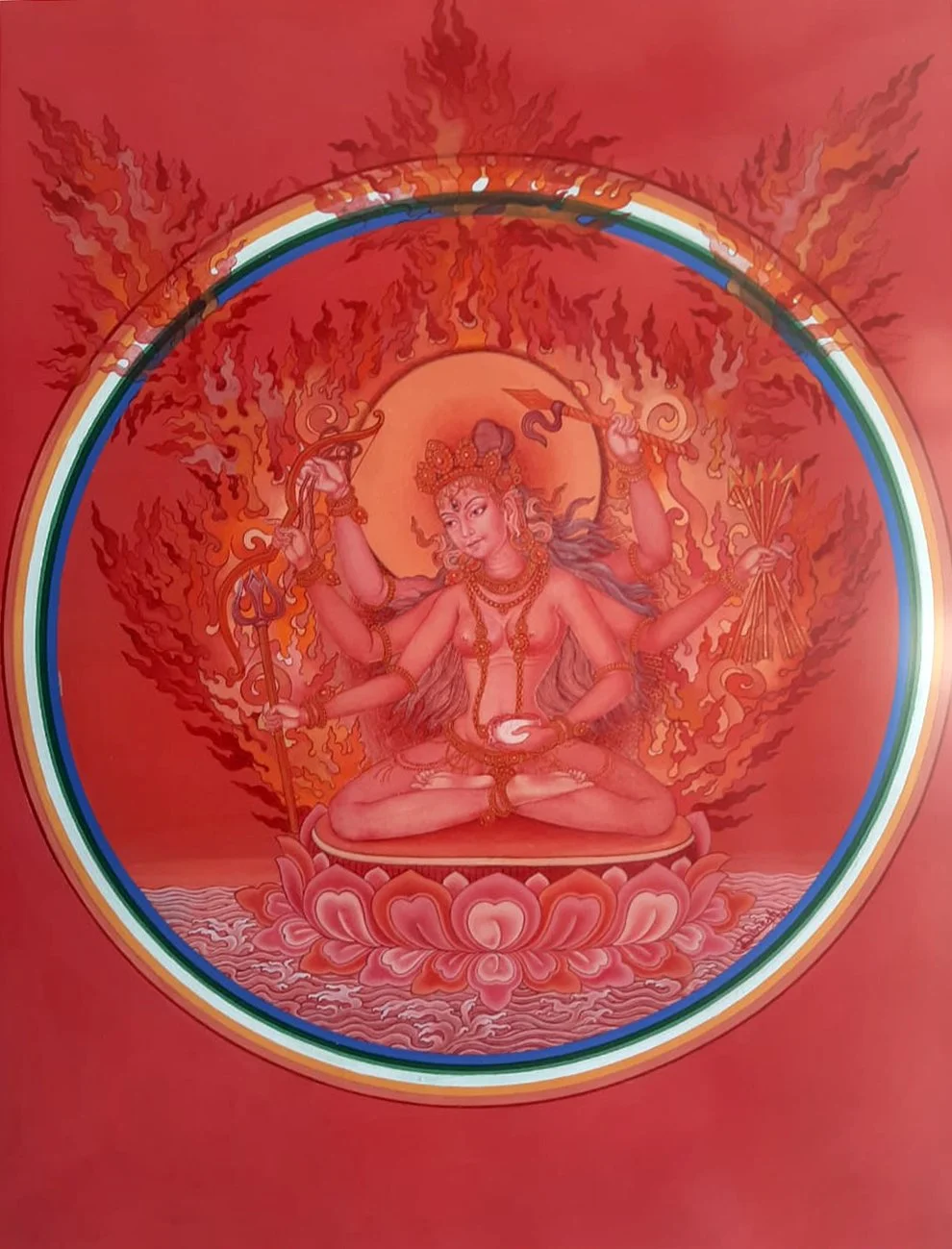
Ma Prana Shakti, a masterpiece by Dinesh Charan Shrestha that beautifully captures the absolute, cosmic life-force of the divine feminine.
A living tradition: Ananda Math and Shaktibad
Our connection to this tradition is my heart teacher, Dharma Bodhi, through the teachings of his heart teacher Swami Satyananda Saraswati, associated with Ananda Math and the establishment of Shaktibad Math near Calcutta, and later on Bihar School of Yoga.
Born in Dhaka in 1900, Swami Satyananda Saraswati became a disciple of Swami Satchidananda Saraswati. According to the traditional history of Ananda Math, he was recognised as the 142nd Guru in its succession. After many years devoted to study, yoga, spiritual practice and service to his teacher, he established Shaktibad Math near Calcutta to transmit the teachings of Shaktibad Dharma.
The Shaktibad Manifesto, published under his name, presents Śakti as fundamental to all existence, describing both material and spiritual dimensions as expressions of power. It also places importance on the development of human potential and the responsible application of that power for the benefit of humanity. The lineage's own accounts describe a path incorporating Tantric Yoga, mantra, Kundalini Hatha Yoga, Laya Yoga, meditation and spiritual discipline.
For us, the importance of this connection is not simply historical. It represents a living transmission of teachings and practices, in which philosophical understanding is inseparable from sādhanā, discipline and direct experience. Our approach also draws upon the wider development of Classical Śākta-Śaiva Tantra, including contributions from traditions such as Trika Śaivism. These influences enrich our understanding, while the teachings of our own lineage remain central to our practice.
The Mahāsiddha Tradition and the Tantrik Heritage of the Himalayas
The history of Tantra cannot be understood through the development of individual schools alone. Across the Indian subcontinent and the Himalayan regions, generations of yogis, Tantrikas and spiritual adepts travelled, taught and practised within a rich landscape of spiritual traditions. Their encounters contributed to a wider culture of spiritual experimentation, transmission and exchange.
One important expression of this heritage is the Mahāsiddha tradition. The Sanskrit term mahāsiddha means “greatly accomplished one” and refers to adepts recognised for their profound spiritual realisation and mastery of yogic and Tantrik practices. Many of the figures associated with this tradition lived during the medieval period and became known through accounts of their lives, teachings, songs and spiritual accomplishments. They were often unconventional practitioners who challenged established religious and social boundaries, placing direct experience and realisation at the centre of the spiritual path.
The Mahāsiddha tradition developed well before the Mughal period. However, the political and social changes that affected India in the centuries of Mughal ruling, violently repressing those who not converted to Islam, greatly shaped the lives and movements of Tantric practitioners, who started retreating towards the mountains for their own protection and peace of mind. The Himalayan region, with their natural remoteness and isolation, with places such as caves prone to practice and seclusion, continued to provide an important environment for the preservation and transmission of different spiritual lineages.
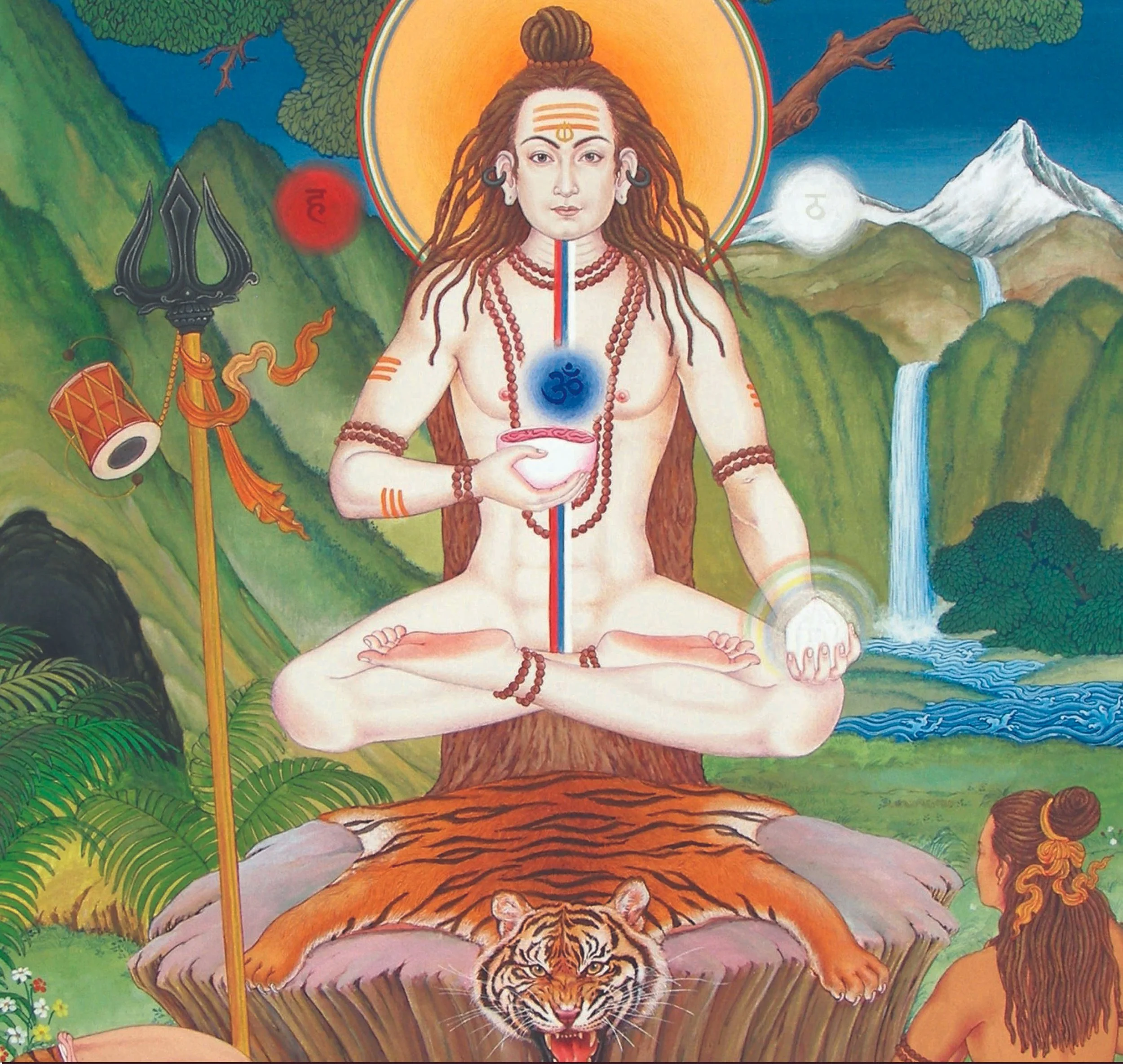
Mahāsiddha Sri Machanda Nātha in a powerful masterpiece by Dinesh Shrestha, masterfully depicting the serene, fluid grace of our root Guru.
A meeting ground of Tantric traditions
The history of the Himalayas reveals a complex relationship between different Tantric traditions. Śaiva and Śākta Tantrikas, Nātha yogis, Buddhist Vajrayāna practitioners and Bönpo masters developed within distinct spiritual systems, but their practices cross-polinated each other much more than these traditions often admit.
This exchange was not organised around sectarian identity, but rather in experimenting among peer practitioners what worked best and more effectively. Practitioners could encounter methods and teachings beyond the boundaries of their own tradition. Yogic practices, krya, subtle-body practice, even mantra, deity yoga, devotional practices, visualisation and approaches to meditation, circulated through networks of teachers, students and adepts.
The relationship between Indian Śaiva Tantra and Buddhist Vajrayāna is particularly important in this history. Both traditions developed sophisticated systems of mantra, initiation, deity yoga, ritual and yogic transformation. Their historical interactions were complex, involving periods of exchange, adaptation that were paralel to the development of distinct interpretations in each of them. Kashmir, being a center point where many of these exchanges happened during this period.
The Bön tradition of Tibet also belongs to this wider Himalayan history. Although Bön had its own origins, teachings and spiritual identity develop long before Buddhism even existed, its tantrik system also developed in a cultural environment in which Buddhist Vajrayāna flourished. Over time, Bönpo and Buddhist practitioners shared a number of ritual and contemplative forms, while preserving their respective traditions and understandings. Dzogchen is a good example of this, a practice embaced by the Bönpos, long before Tibetan Buddhism did.
It is important however not to treat these traditions as interchangeable. Their foundations, teachings, deities, scriptures and paths of realisation remain distinct, and should be respected as such, since they are living systems of liberation with their own technologies. Yet their histories demonstrate that Tantric knowledge cross-polinated between traditions, through a dynamic environment of interaction between practitioners, rather than through isolated spiritual systems.
Sri Machannda Natha and the Nātha heritage
An important figure in this wider history is Sri Machannda Natha, revered as the root Guru of our tradition. also knownn as Matsyendranātha, he is one of the foundational figures of the Nātha and Kaula Tantric traditions. Known through different names and accounts across Indian and Himalayan traditions, Sri Matsyendranātha or Machannda Natha, is remembered as a great yogi and teacher, and as the Guru of Goraksanātha.
His importance extends beyond the history of the Nātha tradition. Matsyendranātha also appears in the religious memory of Buddhist Vajrayāna communities, where figures and accounts associated with him have been connected with the lineage of the Mahāsiddhas. These overlapping traditions offer an important example of the close historical relationships between different streams of Tantric practice.
For our tradition, Sri Machannda Natha represents a connection to this wider heritage of accomplished yogis and Tantric masters. His place as root Guru situates our teachings within a history in which spiritual knowledge was transmitted through direct instruction, sustained practice and the relationship between Guru and disciple.
The Mahāsiddha and Nātha heritage reminds us that Tantra was never just a body of texts or a fixed collection of practices. It is a living oral practice tradition of teachers and practitioners, shaped through centuries of practice, encounter and transmission across India and the Himalayas. This broader history provides an important context for understanding the traditions that inform our own path.
Tantra is a path of practice
Classical Tantra is not simply a philosophy to study or a collection of beliefs to adopt. It is a path of practice, transformation and direct recognition. Different lineages have their own methods and emphases, but several elements are particularly important across many Tantric traditions.
Mantra and sacred sound
Mantra occupies a central place in Tantric practice. It is not simply a positive affirmation or a phrase repeated to calm the mind. Mantras are understood as the energetic bodies of the deities carrying particular powers within them. The concept of Śabda Brahman points towards the profound relationship between vibration and ultimate reality. Bīja mantras, often described as seed syllables, have specific roles within different Tantric practices and are traditionally approached through appropriate instruction, transmission annd practice.
Sādhanā and spiritual discipline
Sādhanā means sustained spiritual practice. It can include mantra repetition, meditation, ritual worship, visualisation, pranayama hatha yoga, krya, and other technologies within a particular system. The purpose is not to produce temporary experiences, but to deepen understanding, awareness and transformation, through consistent and devoted practice.
Kundalinī and Śakti
Kundalinī is an important concept in several Tantric and yogic traditions. It refers to an imense power associated with Śakti that is dormant within every human being. Different tranditions work with Kundalinī in different ways. The understanding of Kundalinī, specially when it comes to its awakening, should not be reduced to physical sensations or dramatic energetic experiences. Its place lays much deeper, within a broader understanding of consciousness, subtle energy movement and spiritual awakening.
Initiation and transmission
In many Tantric traditions, initiation (dīksā) establishes a relationship between the student, the teacher and a particular lineage. A lineage is more than a historical succession of names. It represents the transmission of teachings, methods, responsibilities and verified wisdom and practical knowledge across generations. The relationship between study, practice and transmission is therefore fundamental to classical Tantra.
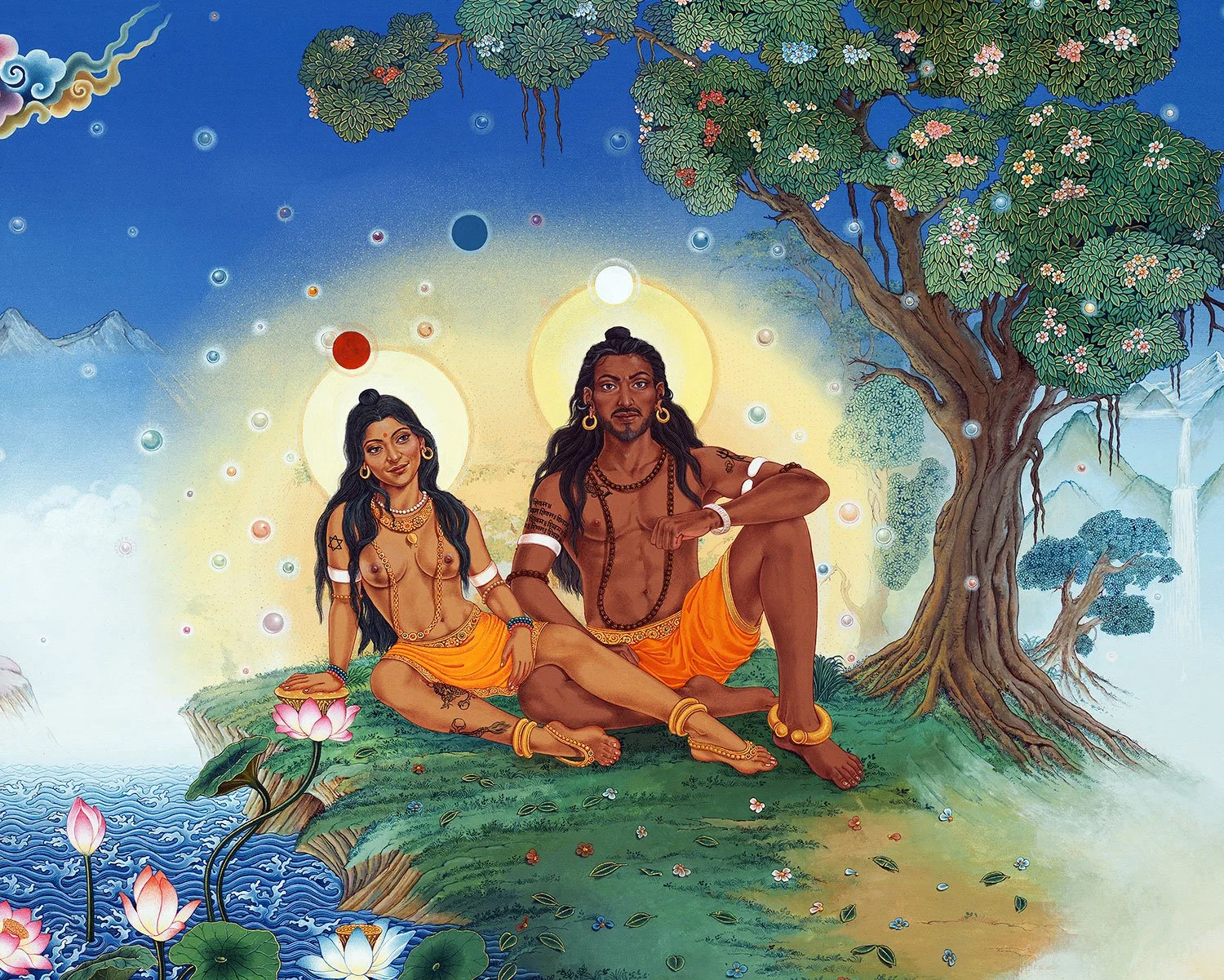
Matsyendra Nātha and Konkanamba, depicted in a masterpiece by Dinesh Shrestha, beautifully depicting the legendary yogi alongside his consort, capturing their shared essence of divine compassion and spiritual grace.
Is Tantra about sexuality?
The modern association between Tantra and sexuality has become so widespread that it often overshadows the actual breadth of the tradition. Sexual rites are indeed present in certain historical Tantric traditions, within very particular contexts of advanced practice, and it would be inaccurate to deny their existence. However, these practices belong to very particular ritual and practice contexts. They do not define Tantra as a whole, and they can only be practiced by advanced practitioners, having taken one another in a mirror-consort path, with verified levels of practice and attainment.
Across many Tantrik traditions, the central elements of yogic practice are mantra, yantra, meditation, deity yoga, ritual, guru yoga, initiation and the realization of our true nature.
Contemporary Neo-Tantra, by contrast, focuses on intimacy, sensuality, relationships, sexual openness and sexual exploration. Some of these approaches may be valuable within their own context, but they are not to be presented as equivalent to Classical Tantra. Classical Tantra is a path of liberation. Neo-Tantra is a path of pleasure awakening, that although spiritualized, revolves around itself, not spiritual liberation, let alone the realisation of one’s true nature. No hedonistic practice, no matter how good it’s intention, can lead to the dissolution of ego.
The distinction matters. The word Tantra has a long and complex history, and using its name does not necessarily mean that a contemporary practice belongs to a traditional Tantric lineage. By the contrary.
At Sacred Grounds, we approach Tantra as a path of self-realization, rooted in Indian spiritual tradition, rather than as a method of sexual exploration or relationship enhancement.
If you are looking to have better and deeper relationships, you can follow it as a path of personal development, without having to call it Tantra. If you are interested in this path, I invite you to try our workshops The Art of Deeper Connection, and The Courage to Be Seen, which far from the hedonistic promises of Neo-Tantra, offer you a grounded path of self-reflection on the patterns, tendencies, and limiting beleifs that keep you from going deeper in your relationships.
Exploring Classical Tantra at Sacred Grounds CNX
At Sacred Grounds CNX in Chiang Mai, we explore Classical Tantra through the Śākta-Śaiva understanding of consciousness and its dynamic power, informed by our lineage teachers and its yogic disciplines.
Through workshops, courses and regular practice, we explore different dimensions of this tradition, including mantra, meditation, Hatha Yoga, the understanding of Śakti and the role of disciplined spiritual practice. Our intention is to make these teachings accessible without stripping them of their depth, context or lineage roots.
Our Tantra Foundations workshop offers an introduction to the view, principles and foundational practices of Tantrik Yoga. Our Mantra Sādhanā workshop explores the role of sacred sound and mantra within this deeper spiritual framework. We also work with Kundalini Hatha Yoga as a traditional method of recalibrating the elements, preparing the body and working with its subtle energies, using specific practices to open and purify the nādīs (energy channels) and support the flow of prāna.
Classical Tantra is a vast field of knowledge and practice. It cannot be reduced to a single technique, philosophy or experience. Its depth becomes clearer through study, practice and an appreciation of the living traditions that continue to preserve and transmit these teachings. This is the tradition we seek to teach, practise and share at Sacred Grounds CNX.
Disclaimer On The Nature of Our Tantra Workshops
All Tantra workshops at Sacred Grounds CNX are strictly non-sexual. There is no nudity, massage, touch, bodywork, or any kind of physical interaction between participants.
Our workshops focus on education, discussion, verbal communication and individual reflection. We honour the tradition, its lineage masters and teachings. All our practices and activities are conducted with respect for Thai law, culture, traditions and local customs.